Ace of Cups
A free-to-read short story about grief and healing.
This story was written by Sarah EA Hart. Please don’t steal. <3
Alaina. My light, my love, my reason for waking up in the morning, the last person I think about before going to sleep at night. I love your kind soul, your impossibly blue eyes, the tender smiles that grace your perfect lips. Your laughter is like silver bells, and your tears are crystal daggers in my heart. I loved you from the moment I met you, and I will always cherish you. I will do anything you ask of me. I promise to love you faithfully, to stand by you, and to care for you—for richer or poorer, in sickness and in health, ‘til death do us part.
As the man in the three-piece suit handed me the urn and shook my hand and said he was sorry for my loss, numbness crept through my fingertips and down my arms and into my chest. His words echoed in my head, slow and slurred, as though he was talking underwater. Or maybe I was the one underwater, drowning, so close to the surface but unable to breathe.
“Again, Mr. Regas, I offer you my deepest and most sincere condolences.” The bell above the front door chimed, and his attention shifted. “My three o’clock is here. Please let me know if you need anything else…”
I carried her through the cold winter air to the car, buckling the urn in the front seat to make sure she didn’t spill on the ride home. “Let’s go home,” I whispered, startled at the cracked edges of my voice. I ached with the pain of men far older than I. It settled into my bones and drummed in my chest, tightening around my heart. What was home anymore, but an empty shell vacated by light and love? I pictured decades of ear-splitting silence and television snow. My fingers turned cold and white, and I loosened my grip on the steering wheel to allow the return of blood flow.
It had started in her blood. The cancer slowly ate its way through her body, rendering her weak and listless—a ghost even before she perished, floating around our house in sweaters and headwraps, consuming little and saying less. She left her smile on for me, even until the last day, knowing I needed a guidelight. Like a moth drawn to flame, I craved the curvature of her lips indicating even a speck of happiness and joy left in her broken body.
The two-story red-brick house with green shutters loomed before me. Once an altar to sheer, unbridled love, it was now a broken shrine of the life we had planned together. Children, a dog, a vegetable garden, prize-winning rose bushes, growing old and gray together—all fading silhouettes of dreams snuffed out too soon. The empty raised beds in the front yard, waiting patiently for seeds that would never be planted, mocked me.
I unbuckled the urn and brought her inside. The last few days had been a dizzying flurry of voices, condolences, and casseroles. Now the house was empty again save for the half-bucket of chicken in the refrigerator.
The lights stayed off, shadowing the den as I laid down on the couch and loosened my tie. Alaina had always tied them for me. Today, the knot was crooked. I pulled the urn against my chest and felt its rigid edges press indentations into my skin beneath the blue button-down shirt Alaina’s mother had given me for Christmas last year.
“What now?” I asked the urn, the house, the universe.

My sweet Alaina held my hand and pulled me through a lush green garden of clover and roses and fruit trees. She laughed—a sparkler on Independence Day, so bright were her beautiful laughs. “Come to me, Leander,” Alaina whispered. I followed her, desperately clinging to her soft, delicate fingers. Three months I’d been without her, and every day had broken me more.
The scent of vanilla and brown sugar surrounded her, and I inhaled deeply, drawing every droplet of her into my lungs. Her long brown hair, thick and shiny in the garden’s sunlight, danced down her back and streamed out behind her like flags fluttering in the morning breeze.
She led me to an old well constructed of worn bricks held together by chipped mortar and creeping vines. “Make a wish.”
“You, my love. Always you.”
She folded my fingers over to make a fist, then opened my hand again. On my palm lay a heavy golden coin with a pomegranate etched onto its gleaming surface. I turned over the coin to see a woman’s face.
“Persephone.” Alaina kissed the coin in my hand, then gestured to the well. “Make a wish, love. She will give you what you need.”
Filling my lungs with vanilla-scented air, I looked down into the well, seeing only a never-ending black hole that swallowed the sunlight. A wave of fear engulfed me, and I pulled away, only to feel my love’s arms wrap around me.
“You are safe, Leander.”
I wished for love. I wished for the shattered edges of my heart to be mended. I wished for Alaina.
The coin fell from my hand, bouncing off the side of the well once before dropping out of sight. I heard a faint splash and felt something inside me that I hadn’t felt since Alaina closed her eyes for the last time: hope.
The alarm ripped me from the dream before Persephone could grant my wish. I awoke on the couch, as I had for the past three months without Alaina. My arm was stiff from holding the urn of ashes against me. I rubbed my face, and my fingertips met thick stubble. My cotton T-shirt, bright white three days ago, now displayed stains from mouthfuls of Chinese take-out and cold pizza. I could nearly read divine messages in the soy and grease splatters.
A whisper from the dream I’d been wrenched from echoed in my ears. Persephone. I sat up, uncurling my arm and shaking it out to spread the tingles of life back into my fingertips. The dream had felt so real.
Slowly, I stood, wiping crumbs from a forgotten sandwich off the couch’s scratchy surface. We’d found it on the side of the road during a Saturday morning drive—the couch, not the sandwich. Navy blue and solid, it had beckoned to us: the newlywed couple with shallow pockets. I promised her I’d buy her a beautiful new sofa one day; for now, curbside navy furniture was sufficient.
As the post-dream haze faded, I felt fatigue and grief thread their way back through my body, twisting and burning. Alone. Still alone. The bathroom seemed miles away, the closet with clean clothing hidden by mountains and guarded by trolls. I finally settled on journeying to the kitchen for coffee, though that in itself was a Herculean task. So many steps.
As I waited for the Keurig to wake up, my gaze wandered over the newspaper on the counter, a relic from an aunt or cousin who had brought it along with a breakfast casserole. An ad in the corner read Tarot readings with Madame Persephone, with an address included underneath the black and white photograph of a woman draped with gauzy scarves. Her dark eyes searched my face with such depth and clarity that I gasped aloud.
Leaving the coffee machine sputtering, I trekked to the bedroom, hiking mountains and battling trolls to claim my prize at last: a clean T-shirt and jeans with minimal holes. The bathroom was next: It didn’t seem so far away anymore as I splashed cold water on my face and shaved off the overgrown scruff.
With the newspaper tucked under my arm, I poured my elixir of the gods into a thermos and stumbled out to my car. The sun kissed my newly-bared cheeks, and I squinted against the light clawing at my eyes. Our heavy living room curtains had shielded me from the sunlight over the past few weeks, and the sudden bombardment of warmth and brightness was unpleasant, if not unwelcome.
After a short drive and a few gulps of too-hot coffee, I pulled off the road into the driveway of a small white house with peeling vinyl siding and a crooked sign in the window promising Fortunes Told Here.
I opened the rusted screen and knocked on the wooden door behind it. A large woman with dark ebony skin and an emerald green silk robe greeted me. She wore slippers on swollen feet.
“Madame Persephone?”
“Yeah. Cash or credit?”
“Cash,” I said, taken aback.
“Good. I don’t take credit cards no more. Damn service costs are too high. Come on back, hon.” The large silk hat she wore was a garish purple-red color, and long yellow earrings dangled from her lobes, brushing against her brown shoulders as she led me into the house and down a cramped hallway to a room covered in silk drapes. In the middle of the room was a small round table and two high-back wooden chairs. A crystal ball, a deck of cards, and a bottle of water sat on the table.
Madame Persephone gestured to one of the chairs, sinking down into the other one with an audible sigh. She wrapped fingers with long, bedazzled nails around the water bottle and placed it underneath her chair, then did the same with the crystal ball. I took my place across the table from her, one hand fidgeting with a small hole on the thigh of my jeans. My other hand drummed a soft nonsense beat on the side of the chair.
She lifted the deck of cards and shuffled them as she spoke in a low, deliberate tone. “You are not here to have your fortune told, I think. Tell me, hon, what is it you are looking for?”
“I’m not sure.” I lifted my drumming hand and stroked the side of my face, surprised when my fingers brushed against smooth skin rather than sandpaper stubble. “I had a dream last night. My wife…” My voice cracked, and I cleared my throat, feeling dust and sand on my tongue. “My late wife… She led me to a well and had me wish on a Persephone coin. When I saw your ad in the newspaper, I…” There was no end to that sentence. What had I thought would happen when I met a fortune teller after a dream? A bead of sweat trickled down the side of my face.
Madame Persephone put down the cards and reached for my hand, and I gave it to her. She smiled reassuringly and patted the back of it with her plump hand. Golden rings sent cold chills through my clammy skin. “Would you like some tea?”
“No, thank you.” My tongue still bore scorch marks from the coffee.
“I’ll get you some tea,” she said firmly, hoisting herself back out of the chair and walking out of the room. With a rustle of silk and a faint click-clack of golden bracelets, she left the room.
Why did I come here? Alaina wasn’t here. Alaina was gone. All I had was the faint wisp of a dream and a coincidental name printed in an old newspaper. I should go.
I could leave while she was making the unwanted tea. It had been an impulsive mistake to leave the house. Half-standing, I realized she might expect to be paid, although she hadn’t given me any fortunes. My hand slid into my pocket, withdrawing my wallet. Crumpled bills fell to the table, but I scooped them back up as I wondered if it would be ruder to leave money. Deciding it would be rude to leave at all, I replaced the wallet in my jeans pocket and sat back down, thumping my left hand against the chair again as my right knee danced a nervous jig.
Click-clack. The golden bracelets returned, along with the fortune teller, who held a chipped peacock mug. She placed it before me on the table, and I traced the handle—the peacock’s neck. “Pomegranate tea,” she explained as I peered down into the steaming red liquid. “For the vibes.” At my confused look, she waved her hands and said with a flourish, “Madame Persephone.” She dropped her arms and sighed. “Pomegranate seeds… Persephone… You don’t know your Greek mythology, do you?”
I mumbled a winding apology. She waved it off and shuffled the deck again. I watched in amazement as her large hands riffled the cards, then bridged them with a satisfying khhhk. She dropped the deck on the table and tapped the top card with a bejeweled nail. “Cut the deck, hon.”
“It’s Leander.”
“Cut the deck, Leander.”
I did so, and she stacked the other cards on top. She had me do it twice more, then nodded to herself, earrings dangling wildly like two excited canaries fluttering about. Drawing a card, she laid it face-down on the table. “Your past,” she said. A second card. “Your present.” And a third. “Your future.”
She turned over the first card. “Ah,” she said with a nod, stroking the card’s glossy finish. “The Nine of Pentacles.” I leaned over to see the image clearly. A woman was tending to her garden of tomatoes and pentacles. She held home-grown carrots in her hands, and a bird rested on her wide-brimmed straw hat as she smiled softly.
“You were content,” murmured Madame Persephone. “You toiled, you worked hard, and you enjoyed the harvest. You built the life you wanted, and you lived it.” She glanced up at me as if for confirmation. Her dark brown eyes searched my face.
I opened my mouth, expecting dust to fly out, it was so dry. Instead, I spoke hoarsely. “The wedding was almost two years ago. We bought a house. I built her raised beds for her garden. We were planning our future together.”
“I’m sorry for your loss,” she said quietly. I looked down at the card as it blurred for a moment. Blinking cleared my vision as she turned over the second card. “The Ten of Swords. Your pain… it is all-consuming.”
My eyes drifted to the second card. A girl in a pink sweater lay on her side on the ground. Ten long swords had been stabbed through her body. I felt each blade through my own body. They’d held me to the navy couch for three months.
“It will get better,” she said firmly. “It doesn’t feel that way right now, to you. You cannot see past the piercing agony. But it will be okay. You will be okay.”
“Not without her.” Pain gripped my stomach, turning it inside out. I clutched the edge of the table, bending over. “I won’t feel that way again. Ever.”
“Drink some tea,” Madame Persephone commanded, and I did so. The warm liquid coursing through me helped relax my body enough to breathe again. “There.” She reached out again and enveloped my hand in one of hers, squeezing hard. “Leander, listen to me. We all go through difficult times in life. We go through them. We don’t stop and stay forever. I know it hurts.” Her hand tightened even more on mine, nearly crushing it. “Hon, I can see the grief written in your eyes. But one day…”
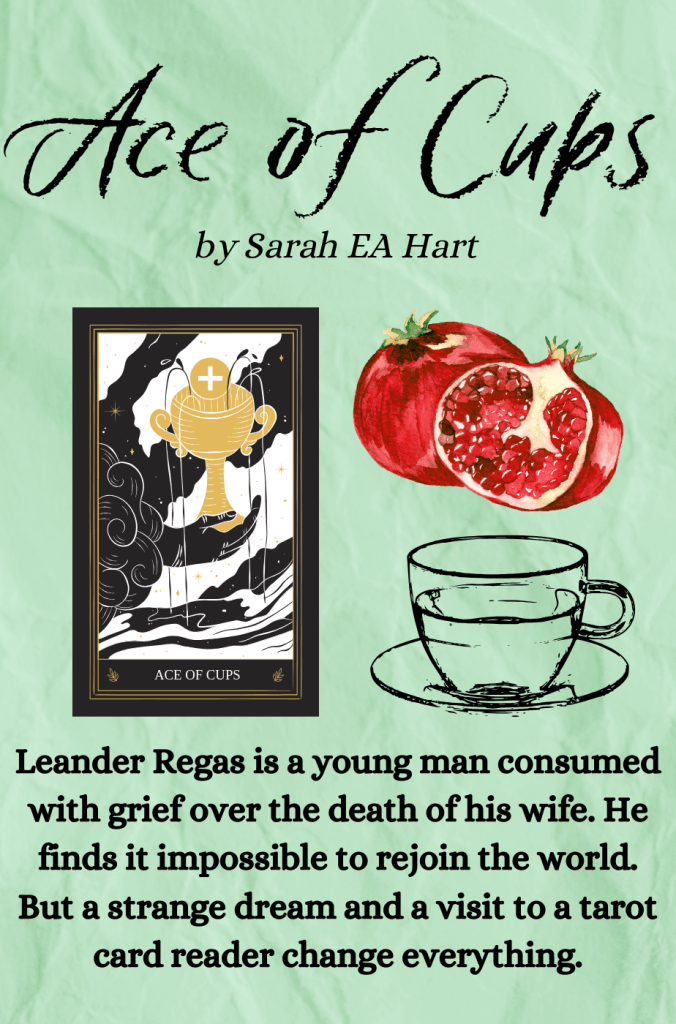
She reached with her free hand and flipped over the last card, studying it with a smile. A large pink cup sat on an outstretched hand appearing through clouds. Water poured out of the top, and a blue heart emerged over a brilliant sun. “See? The Ace of Cups. Your cup will run over, full of life and love. The sun will shine again.”
“I have to go.” I felt bile at the back of my throat, threatening to manifest itself. She’s not here. I couldn’t stand hearing someone tell me that my life without Alaina would be okay. This fortune teller didn’t know how vibrant and alive Alaina had been… until she wasn’t. She didn’t understand that I couldn’t see the sun anymore. I couldn’t hear birds or music, or taste milk and honey. “It was a mistake to come here. I’m sorry.”
My chest constricted and the card’s image blurred, then darkened. A faint sheen of sweat dampened the back of my neck. The chair scraped backward as I rose and dropped the crumpled bills on top the cards. I moved the chair back so I wouldn’t trip as I fumbled my way to the door, tasting pomegranates and salty tears. Her bracelets clacked together frantically as she followed me down the hallway.
“Leander—”
Sunshine. Light. A faint breeze blew on my face as the front door flew open, and I greedily sucked in air as I made my way back to the car. She watched from the doorway, filling it with her green silk and pained expression as I backed out of the driveway.
She was wrong. Without Alaina, I was only a husk, an empty shell, a sandcastle destroyed by the relentless waves. My heart had burned with her body and rested in ashes alongside hers. Sunshine was a stranger now.

Back to the scratchy blue couch, cold pizza, sandwich crumbs, and trolls guarding the bedroom. Alaina’s urn remained a constant companion, joining me in the bathroom and the kitchen on the few occasions I ventured from the den for necessary biological breaks. Otherwise, I stayed on the couch, the urn beside me as we watched old sci-fi shows on Netflix together.
My cell phone rang three days later. I reached over to decline the call and hit the green button instead. Fuck. “Hello?” The word squawked out of my unused throat.
“Leander Regas?” I almost recognized the voice but couldn’t place it. Female, deep and sturdy, and sure of herself.
“Yes. Who is this?”
“Madame Persephone. You came in for a reading the other day?”
Shit. Had I not paid her enough? “How much do I owe you?”
“I just called to check on you. You were upset when you left. I looked up your name online. There aren’t a lot of Leanders in this town.” A hint of a smile trickled through the phone speaker. I gritted my teeth against the warmth.
“I’m fine.”
“I wanted to offer you a cup of tea and a friendly ear. I lost my husband a few years ago, after thirty-three years of marriage. I know how difficult it can be.”
I still don’t know how she did it, but she convinced me to return to her house. All afternoon, we sipped tea and told stories and laughed and cried. Madame Persephone’s thick, ringed fingers held my hand when I doubled over in pain, squeezing hard to remind me someone else was there. Grief burned in my stomach, twisting like a knife, but the more I talked about her, the less it burned, until it was only a smoldering coal that I doused with pomegranate tea.
I spoke about Alaina’s garden plans—the fruit trees we were going to plant, and the vegetables she wanted to grow. The colorful rose bushes with a white arbor trellis and a little stone bench nearby for our future children to sit on. The swingset I’d build in the backyard. I told her of Alaina’s laughter, how it lit up the night sky, and I told her about the last few months of her life, when the light in her eyes slowly dimmed more each day.
Madame Persephone talked about her husband Gregory, how he did everything around the house when he was alive. He’d replaced their kitchen cabinets, changed the lightbulbs, cleaned the gutters, and mowed the lawn. “My office light’s been out for months,” she said with a shake of her head. “I’m afraid to get up on the stepladder to change it. My old legs won’t hold me, with the lymphedema.”
“Oh, I can do that for you, Madame Persephone. No problem.”
She laughed. “It’s Stefanie. That’s my stage name.”
“Right,” I said with a laugh to match hers as she went and got the stepladder.
I visited Stefanie’s house a couple of times a week at first, then every couple of days. Eventually, she came to my house and helped me vacuum the crumbs and throw out the rotten pizza in the refrigerator. She dusted the blinds and threw open the curtains, letting in light.
One sunny spring day, she unloaded herself from her car in my driveway, dressed in blue jeans overalls, a bright yellow shirt, and a red headscarf. I was on my knees in the dirt, planting carrot seeds in the raised beds.
“Leander!” she said in her strong, bellowing voice. “What are you doing?”
“Planting carrots.”
“It’s a little late for carrots, hon.”
“Better late than never.”
She threw back her head and laughed. It was a beautiful sound. Like clock tower bells. “Then I’d better get my gardening gloves out of my trunk.” She knelt beside me and tucked the tender tomato plants into rich soil. When we were done, I helped her off the ground and she groaned, rubbing her knees. “I’m getting old.”
“Not that old,” I argued.
We went inside, and I poured her a glass of lemonade as she rested her legs. I moved a stool over for her to rest her swollen feet on, and she sighed in contentment as I handed her the lemonade. “You are too good to me, Leander.”
“Well, you’ve been good for me,” I pointed out.
Stefanie smiled and patted the couch next to her. I sat beside her and held out my own glass of lemonade. “To you, for helping a depressed man crawl out of a dark place.”
“To you, Leander,” she returned. “For getting an old woman up and moving again.”
“You’re not that old,” I protested again, and she cupped my face with one of her thick hands, her rings pressing against my shaven skin.
“You are too sweet.” She patted my face, then dropped her hand back into her lap.
Over the next few months, the raised beds filled with carrots and tomatoes and peppers. Stefanie and I made salads with the vegetables we had grown—the fruits of our labor. Somehow, the salads tasted so much better coming from my own soil. I mowed her lawn for her, and she made pomegranate tea and cookies.
The rosebushes never panned out. But we did plant butter-yellow daffodils all the way down the path to the front door, as well as a large blue hydrangea bush at the corner of the house overlooking the garage. Stefanie gifted me with lily bulbs from her own garden, and we made a small memorial flowerbed together. She patted my shoulder while I cried shamelessly.
“Leander,” she called to me loudly one day while I was cleaning the gutters at her house. “Come down from that ladder and have some soup.” I knew better than to argue with her. She had made tomato soup and grilled cheese sandwiches. A memory of my mother making me the same meal when I was sick as a child sparked in my mind. I should call her. I hadn’t spoken to my family in weeks. I’d left their calls unanswered, their emails unread. I hadn’t wanted to hear the pity and worry in their voices.
I introduced Stefanie to Star Trek and Firefly and Babylon 5—shows Alaina and I had watched together many times. Stefanie howled with laughter at the cheesy humor and sobbed with me during the sad moments. I got to watch my favorite shows through fresh eyes. And over time, I began to feel something. Only a little something, but it was there. Feelings, plural. Emotions other than all-consuming pain and despair. I was feeling again.
One late summer day, I finished changing the lightbulb in her psychic reading room and folded the stepladder. My hip bumped against the round table, and her deck of tarot cards fell. I bent down to pick them up, stacking them neatly. One last card had fallen underneath the table; I reached back down and picked it up.
Stefanie came in just as I retrieved the card, and I handed it to her with a smile. She took the Ace of Cups, looking down at it thoughtfully, then held it out to me.
“Is your cup running over, Leander? Is the sun shining again?”
I took her hand instead of the card and pulled her close, smiling at the look of surprise she gave me. “Yes, Stefanie. It is.”

The End
 saraheahart.com